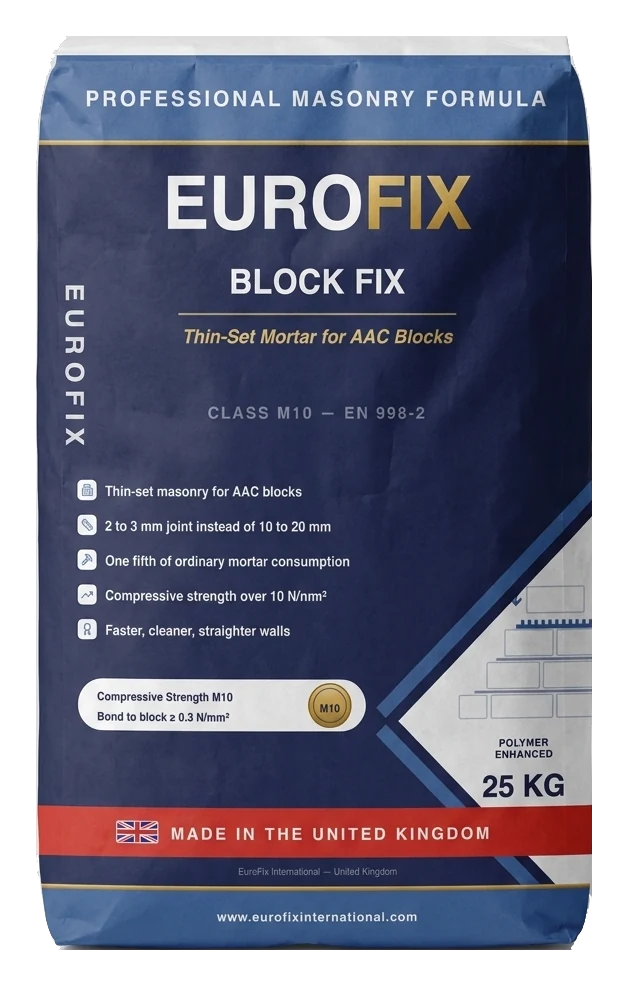
EuroFix Block Fix
Thin-bed masonry mortar for AAC / lightweight block, 2–3 mm joints instead of thick beds
Description
A certified thin-bed cementitious masonry mortar to EN 998-2, designed for laying autoclaved aerated concrete (AAC / gas-concrete) and lightweight blocks with thin 2–3 mm joints. It replaces traditional thick (10–20 mm) sand-cement bed joints, eliminating thermal bridging, saving large volumes of mortar, speeding up laying and producing a stronger, more thermally homogeneous wall.
Fields of Application
- Laying AAC and gas-concrete blocks
- Lightweight blocks and dimensionally accurate sand-lime brick
- Interior, exterior and insulating partition walls
- Structures requiring high thermal performance
- High-efficiency replacement for thick site mortar
Technical Properties
| Property | Value |
|---|---|
| Mixing ratio | 6–6.5 L water per 25 kg bag |
| Maturing time | 5 min, then re-stir |
| Pot life | 2–3 hours |
| Open time | ≈ 20 min |
| Adjustment time | 7–10 min |
| Joint thickness | 2–3 mm (thin-bed) |
| Application temp. | +5°C to +35°C |
| Initial load | After 24–48 hours |
| Full cure | 14–28 days |
| Compressive strength | ≥ 10 N/mm² (M10) |
| Bond to block | ≥ 0.3 N/mm² |
| Service temp. range | −20°C to +70°C |
Surface Preparation
- Blocks must be dimensionally accurate, with flat faces, free of dust and breakage.
- Level the first course precisely on the base with traditional levelling mortar and set it horizontal.
- Clean block faces of dust and lightly dampen them in very dry conditions.
Application Method
- Add the powder gradually to clean water and mix with a slow drill until a lump-free paste forms.
- Let the mix rest 5 minutes to mature, then re-stir before use.
- Spread the mortar on the horizontal course face with the dedicated block-notch trowel at 2–3 mm.
- Place the block and tap with a rubber mallet to align it horizontally and vertically.
- Fill vertical (perpend) joints with mortar where the design requires.
- Remove excess and check the level of each course before moving to the next.
Consumption
| Use | Rate |
|---|---|
| Wall with 10 cm blocks | ≈ 3–4 kg/m² |
| Wall with 20 cm blocks | ≈ 5–7 kg/m² |
| Per volume of masonry | ≈ 25–35 kg/m³ of blocks |
Comparison vs. Ordinary Site Mix
| Criterion | Ordinary Mix | EuroFix |
|---|---|---|
| Joint thickness | 10–20 mm thick | 2–3 mm thin |
| Thermal bridging | Significant through thick joints | Near-zero — homogeneous wall |
| Mortar consumption | Very high (thick beds) | ≈ 70–80% lower |
| Laying speed | Slow, constant levelling needed | Fast with accurate blocks |
| Wall integrity | Uneven strength across joints | Strong, homogeneous AAC bond |
| Insulation efficiency | Degraded by the joints | Preserves full insulation value |
Consumption & Cost
Thin-bed mortar looks more expensive than sand and cement at first glance, but it is genuinely cheaper for AAC masonry: the thin 2–3 mm joint uses roughly 70–80% less mortar than a traditional thick (10–20 mm) joint, meaning far fewer bags per cubic metre of wall. Add the faster laying that cuts labour, and — crucially — it eliminates the thermal bridges that squander the expensive insulation value of AAC blocks; using thick mortar on an insulating block defeats the whole point of buying it. EuroFix Block Fix preserves the wall's thermal performance and builds faster with less mortar.
Packaging
25 kg bag — 48 bags per pallet
Storage & Shelf Life
Store in original sealed bags in a dry place, raised off the ground on wooden pallets. Shelf life 12 months from the production date printed on the packaging.
Safety
Contains cement which reacts alkaline with moisture. Wear protective gloves and goggles. On eye contact, rinse with plenty of water and seek medical advice. Keep out of reach of children.