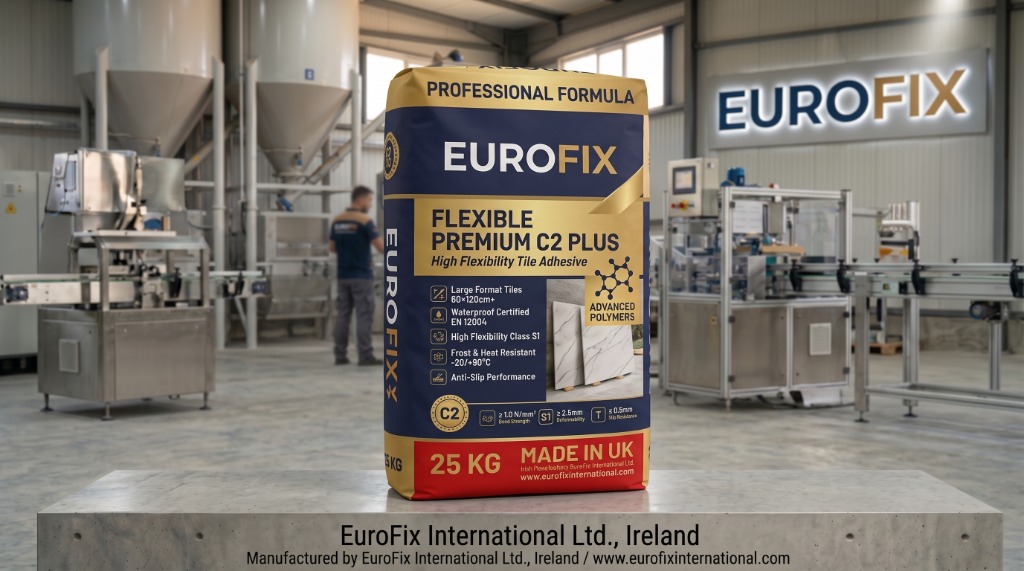
UK R&D Lab — For decades, traditional sand-and-cement mortar mixes have been the standard method for bonding ceramic tiles and stone to wall and floor substrates. However, structural and civil engineering assessments reveal critical mechanical, logistic, and load failures inherent in this outdated approach. Today, we present a comprehensive comparison between modern **EuroFix polymer-modified adhesives** and **traditional sand & cement mixtures**.
The Structural Dead-Load Conflict
According to , Chief of Polymer R&D, a traditional sand-cement tiling bed requires a massive thickness of **30mm to 40mm** to secure sufficient mechanical grab on concrete walls. This translates to an extreme structural dead-load of **75kg per square meter (kg/m²)**. Under high-rise loads, this massive weight leads to micro-cracking and slab deflection, and increases column load specifications by 15%.
In contrast, EuroFix polymer-modified thin-bed adhesives operate at a thickness of only **4mm to 6mm**. Because our custom acrylic polymer chains form chemical covalent bonds with the tile substrate, the mechanical dead-load is slashed to just **6kg/m²** (a **92% reduction**). This massive weight reduction saves thousands of tons in high-rise structural designs, allowing engineers to reduce reinforcement steel requirements.
Comprehensive Technical B2B Comparison Table
| Technical Parameter | Traditional Sand & Cement Mix | EuroFix Polymer-Modified Adhesive |
|---|---|---|
| Bed Thickness Required | 30mm - 40mm (Thick-Bed) | 4mm - 6mm (Thin-Bed) |
| Structural Dead-Load | 75 kg/m² (Severe load on walls) | 6 kg/m² (92% weight reduction) |
| Bonding Mechanism | Pure mechanical interlocking (brittle) | Chemical polymer matrix + mechanical key |
| Tension Adhesion Strength | 0.2 - 0.3 N/mm² (Prone to delamination) | > 1.5 N/mm² (Indestructible Class C2) |
| Substrate Vibration Shear | Zero (Adhesive snaps under vibration) | High (Class S1/S2 elastomeric absorption) |
| Logistics & Transportation | Extreme bulk (High fuel & delivery cost) | Minimal volume (90% lower freight expense) |