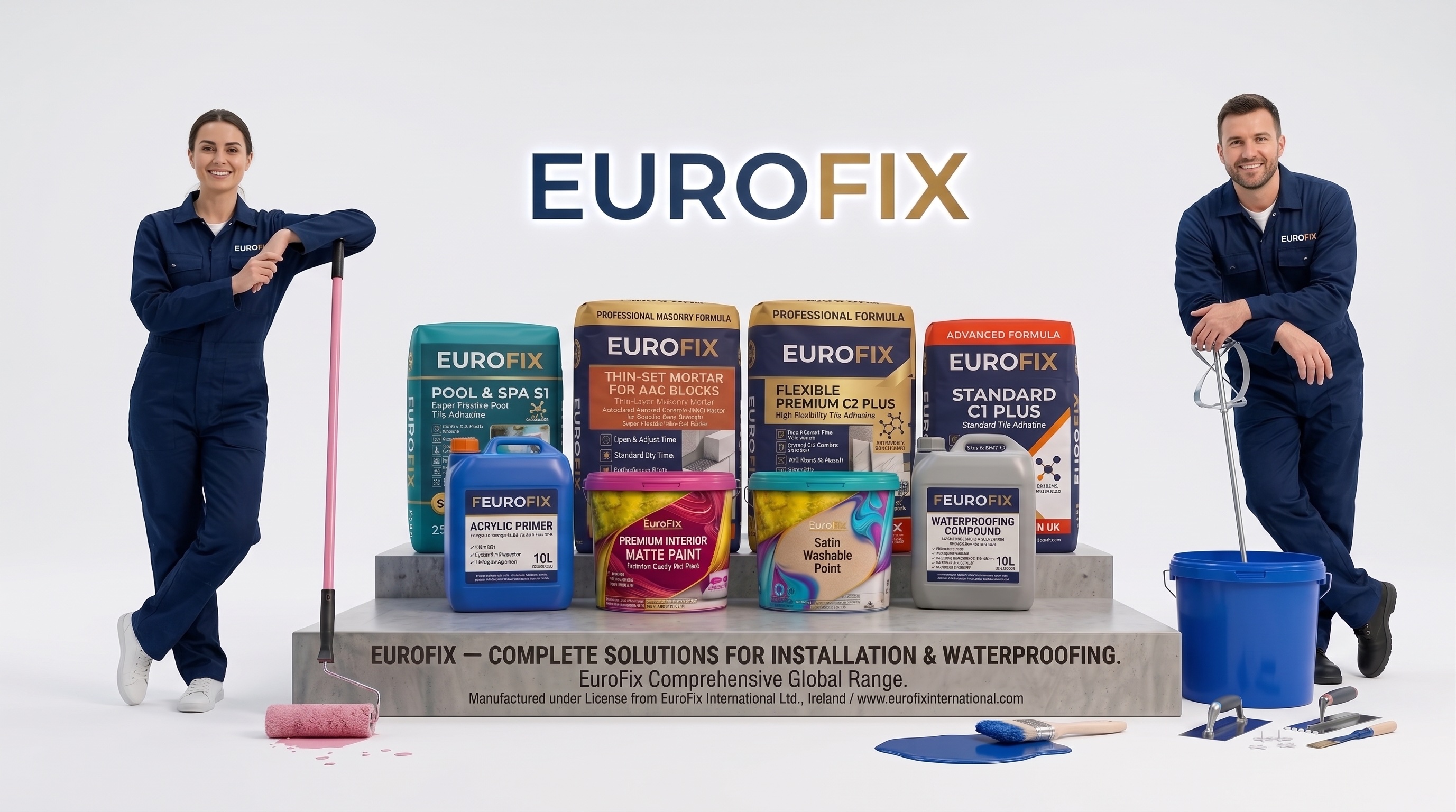
Selecting the wrong tile adhesive is the single most common cause of tile failure in construction projects. According to industry data, over 60% of tile delamination cases result from using an adhesive with insufficient classification for the project conditions. This comprehensive guide explains the European EN 12004 classification system and provides a decision framework used by EuroFix's own project engineers.
EN 12004 Classification Decoded
C1 — Normal-setting cementitious adhesive. Tensile adhesion ≥ 0.5 N/mm². Suitable for: standard ceramic tiles on absorbent substrates, interior walls and floors. EuroFix product: EuroFix Standard C1.
C2 — Improved cementitious adhesive. Tensile adhesion ≥ 1.0 N/mm² (double the C1 requirement). Suitable for: porcelain, natural stone, large-format tiles, exterior installations. EuroFix product: EuroFix Flexible Premium C2.
T — Reduced slip. The adhesive resists sliding on vertical surfaces. Essential for wall tiling with heavy tiles.
E — Extended open time (≥ 30 minutes). Allows repositioning of tiles after application. Critical for large installations where speed varies.
S1 — Deformable adhesive. Transverse deformation ≥ 2.5mm. Essential for: underfloor heating, swimming pools, facades, substrates subject to vibration or thermal movement. EuroFix product: EuroFix Pool & Spa S1.
Decision Guide: Which Classification Do You Need?
Interior floor, ceramic tiles? → C1. Porcelain or natural stone? → C2TE. Underfloor heating or swimming pool? → C2TE S1. External facade above 3 meters? → C2TE S1 minimum. When in doubt, always choose the higher classification — the cost difference between C1 and C2 is typically only 15-20%, but the performance difference is 100%.