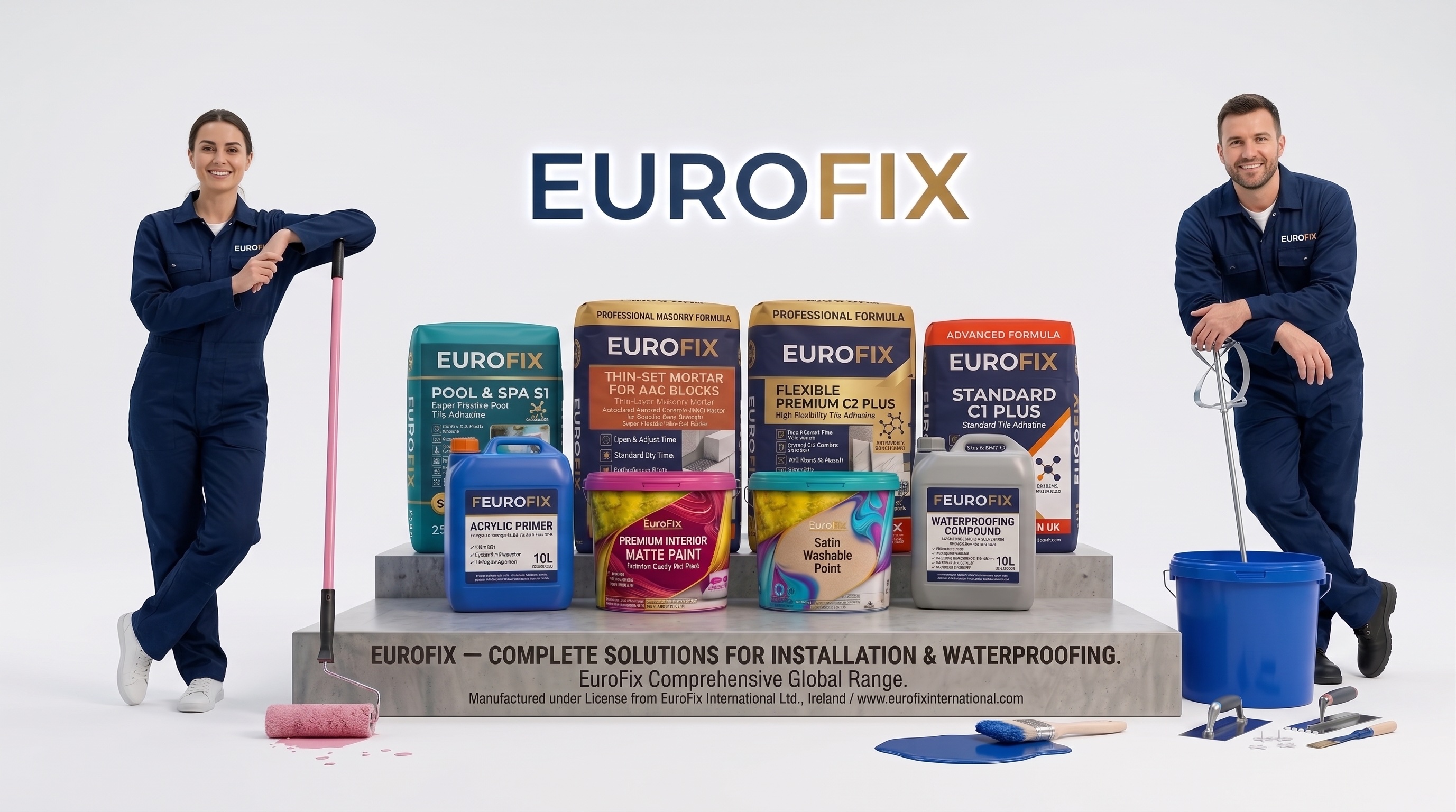
Hama, Syria — A construction chemical is judged twice: once in the laboratory, and once on the wall — years later. EuroFix Syria is being built so that the second judgement never comes as a surprise. This article sets out, plainly, how quality will actually work at the Hama plant: what gets tested, how often, against which standards — and how Syrian-made EuroFix products will obtain national certification alongside international methodology.
1. It starts with the sand, not the bag
Sand and fillers make up the majority of every dry mix — so incoming raw materials are the first quality gate. At Hama, every delivery of sand is checked before it enters a silo: moisture content (measured, not guessed), grading through calibrated sieves, and cleanliness — because clay content is the silent killer of adhesive strength. Cement, gypsum and functional additives are accepted only against supplier certificates of analysis, verified by our own checks.
2. Every batch tested — not sampled occasionally
The production rule at EuroFix Syria is simple: no batch ships without its test record. The plant laboratory runs the working battery of EN-method tests used across the EuroFix network:
Tile adhesives: tensile adhesion (EN 1348 methodology), open time (EN 1346), slip resistance (EN 1308), workability and water demand — plus 28-day adhesion series maintained on a rolling basis.
Gypsum plasters: setting time (Vicat), consistency, and surface finish panels.
Every product: the batch number printed on each bag links the physical product to its full laboratory record — raw-material lots, mixing profile, test results, operator and date.
3. One methodology across the network
EuroFix Syria does not invent its own definition of quality. The Hama laboratory operates under the same test methods, acceptance limits and formulation controls applied to EuroFix products in other markets. Recipes are locked digitally; any adjustment requires a documented technical decision — not an operator's judgement on the floor. The result the customer feels is consistency: bag after bag behaving the same way, which is precisely what professional installers value most.
4. The Syrian certification path — SASMO
International methodology does not replace national certification — it prepares for it. EuroFix Syria is working through the Syrian conformity path with the Syrian Arab Organization for Standardization and Metrology (SASMO): product registration, conformity testing of tile adhesives and gypsum-based products against the applicable Syrian standards, and the labelling requirements for locally manufactured goods. The objective is straightforward: every EuroFix bag produced in Hama carries both — European-grade test methodology and Syrian national certification.
5. Performance reviews that never stop
Quality control does not end at the factory gate. The system is designed for continuous performance evaluation: retained samples from every batch stored for later verification; periodic re-testing across the shelf life; site feedback from certified installers flowing back through the EuroFix Academy; and batch-level QR traceability that lets the company see how products move — and act early, before a complaint ever forms.
Quality, in the end, is not a certificate on a wall. It is a habit repeated on every batch, every day. That habit is what EuroFix Syria is being built around.